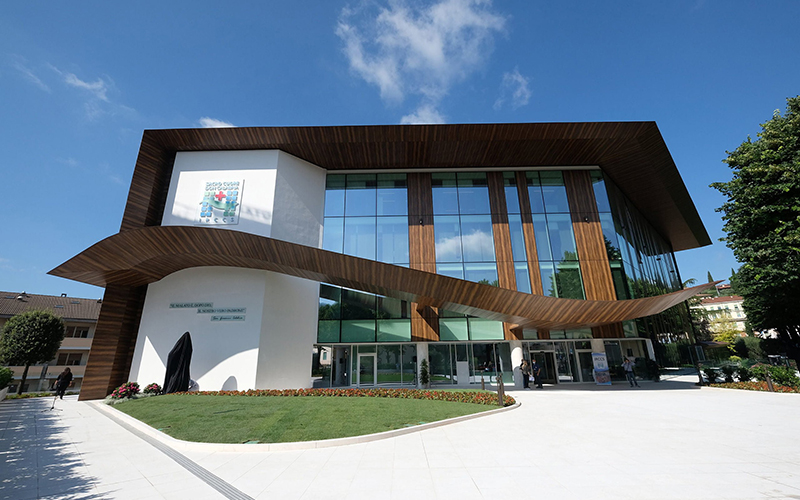
Ospedale Sacro Cuore Don Calabria
Verona
Italy

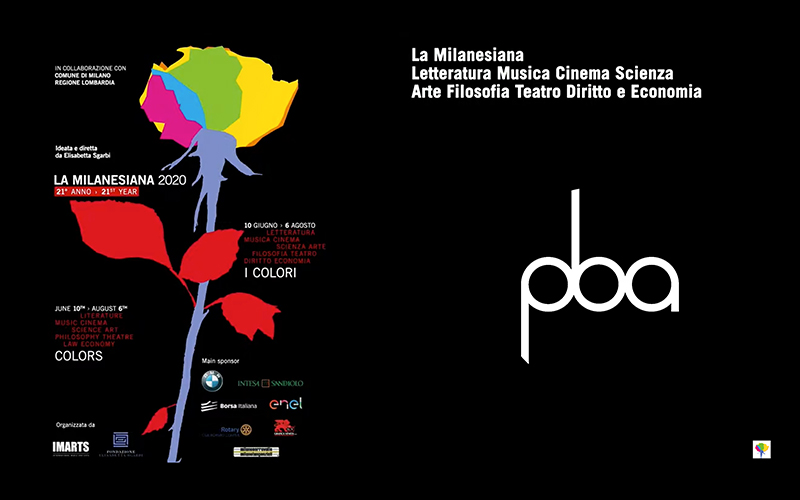
Literature Music Cinema Science Art Philosophy Theatre Law and Economy
Ideata e diretta da Elisabetta Sgarbi
Milano | 10 giugno – 06 Agosto 2020
La XXI edizione si terrà dal 10 giugno al 6 agosto con oltre 40 incontri, 115 ospiti italiani ed internazionali, 5 mostre 12 città e un tema, quello scelto da Claudio Magris, ‘I Colori’.
La kermesse sarà aperta il 10 giugno con una serie di appuntamenti di ‘Aspettando La Milanesiana’ in collaborazione con Corriere.it. Il 10 giugno in streaming ci saranno Thomas Piketty in dialogo con Ferruccio De Bortoli sui temi presenti nel nuovo saggio dell’economista, ‘Capitale e Ideologia’ edito da La Nave di Teseo. Un appuntamento in collaborazione con la Fondazione Giangiacomo Feltrinelli.
Il 15 e 16 giugno due incontri in streaming avranno come protagonista lo spazio e la scienza con gli astronauti italiani Samantha Cristoforetti e Luca Parmitano e due lectio sui colori dello spazio.
A Milano dal primo luglio al via gli appuntamenti dal vivo, con ingresso libero fino a esaurimento posti, con lo spettacolo di Massimo Lopez e Tullio Solenghi nel cortile del Castello Sforzesco.
Il cortile di Palazzo Reale ospiterà il 27 luglio ‘I colori della nostra vita. Questo virus che rende folli’, spettacolo di Bernard – Henri Lévy introdotto da Maurizio Molinari.
Il 29 luglio nel chiostro del Piccolo Teatro Grassi andrà in scena una lettura collettiva di La Tregua di Primo Levi.
Il 25 luglio il cortile di Palazzo Reale ospiterà ‘I Colori di Fabrizio De André’, la proiezione del documentario di Walter Veltroni ‘Fabrizio De André e Pfm – Il concerto ritrovato’, con letture di Dori Ghezzi e dello stesso Veltroni.
A Casalpusterlengo, in provincia di Lodi nella ex zona rossa, il 15 luglio Vittorio Sgarbi terrà una lectio sui tesori dell’arte di Lodi, Codogno e Casalpusterlengo.
A Sant’Arcangelo di Romagna il 4 agosto Vittorio Sgarbi terrà una lectio illustrata su Guido Cagnacci, Tonino Guerra e Federico Fellini, con il prologo musicale degli Extraliscio che hanno realizzato anche la nuova sigla della rassegna.
Il 30 luglio al Museo Madre di Napoli si terrà l’apertura della mostra ‘Nuvole e colori’ che raccoglie alcune fotografie di Carlo Verdone, attore e regista, che dialogherà per l’occasione con Paolo Mereghetti.
More information http://www.lamilanesiana.eu
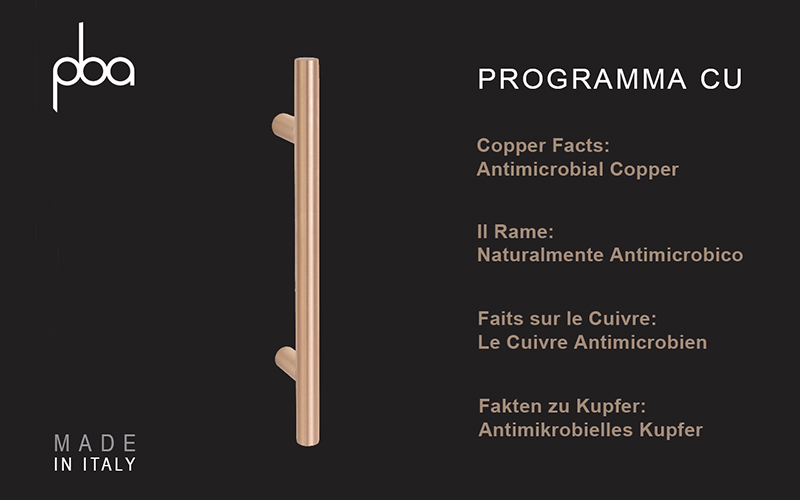
La nouvelle gamme pba CU: Cuivre + Acier inox démontre que l’utilisation de produits fabriqués à partir de matériaux appropriés et avec un design élégant et moderne peut représenter une réponse efficace au problème de la contamination bactérienne en contribuant à maintenir les environnements plus sains et plus propres.
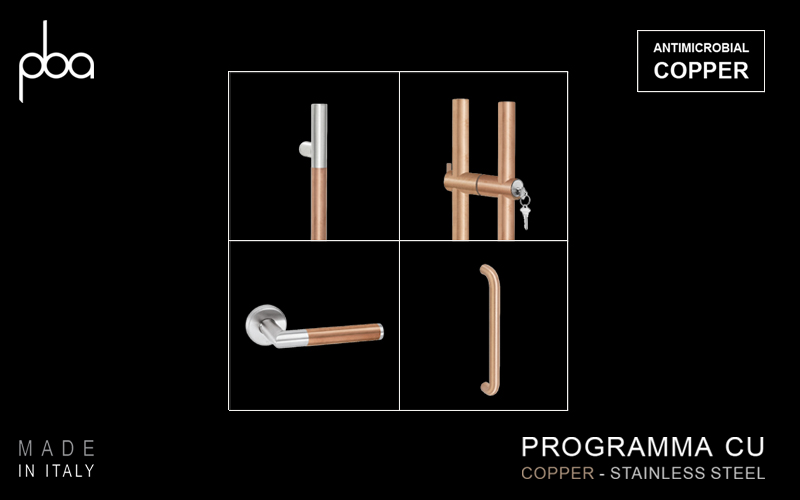
Dans le programme CU: Cuivre + Acier inox, les designers peuvent choisir parmi des poignées de tirage. Des béquilles, des poignées avec serrure et plaques avec serrure pour porte vitrées en cuivre pur ou en cuivre pur et acier inox 316L.
Nous avons conçu cette série en utilisant i meilleur acier, l’acier inoxydable 316L, et le meilleur matériau antimicrobien, le cuivre, afin de réaliser des produits de haute qualité en terme de propriétés soit mécaniques soit antimicrobiennes. Les propriétés antimicrobiennes et antibactériennes du cuivre vers différents micro organismes pathogènes, y compris le SARM (S.A. AkA staph ) et E.Coli, sont scientifiquement prouvées.
Le New England Journal of Medicine a récemment publié que le cuivre, par rapport aux autres matériaux, est nettement moins accueillant pour les virus.
Les produits CU + Acier inox peuvent être considérés dans le cadre d’un plan visant à avoir des environnements plus propres et aseptisés, en particulier pour les lieux et espaces publics tels que les bureaux, les salles de réunion, les hôtels et les centres de santé.
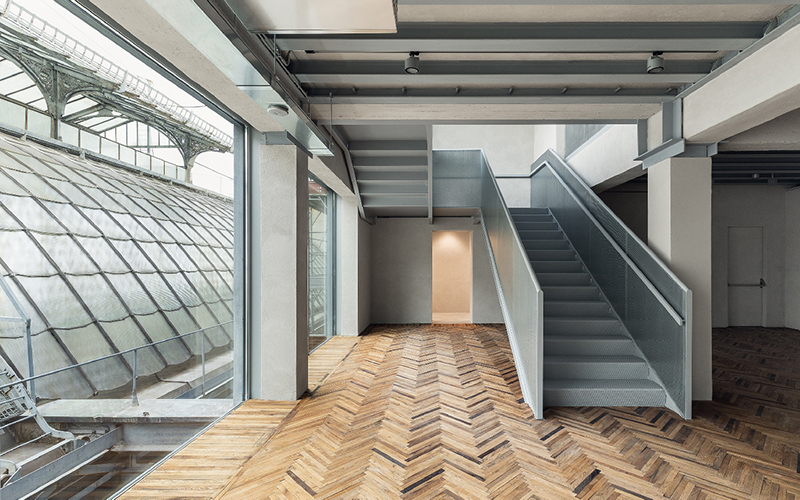
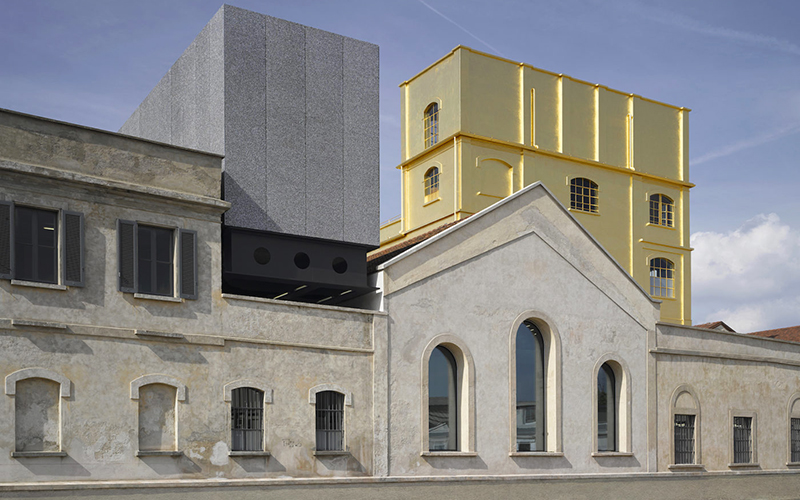
Project: Osservatorio Fondazione Prada
Architects: Prada and OMA – Office for Metropolitan Architecture
Location: Milano – Italy
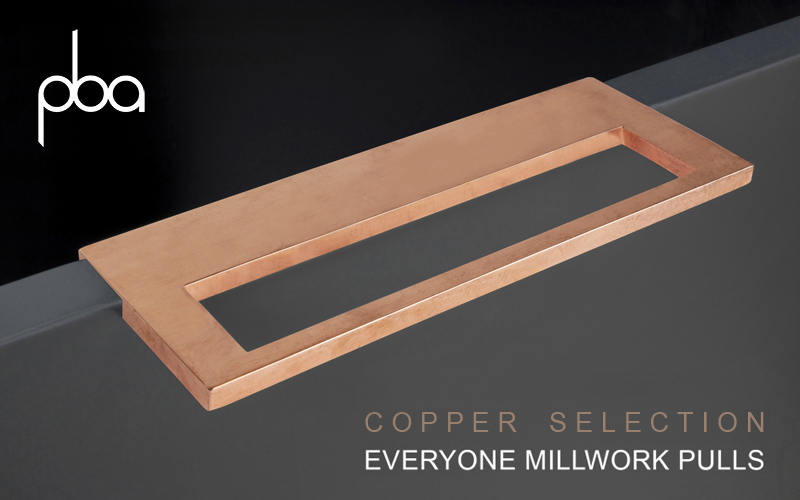
Everyone Millwork Pulls from pba have become a go-to solution for interiors professionals and cabinetmakers since their 2018 introduction. Originally offered and still available in top-grade stainless steel, they meet the ada accessibility requirements and support inclusion beautifully.
Now our pulls are better than ever with a brand new option: copper plating, where an alloy consisting of 97% pure copper is applied without coating to a steel core to create an always-on, antimicrobial defense against a range of pathogens including MRSA, S. Aureus (A.K.A. Staph), and E. Coli.
The New England Journal of Medicine recently reported that copper, when compared to other materials including plastic and stainless steel, is also dramatically less hospitable to virus. With all this and good looks, too, pba copper millwork pulls can be part of a comprehensive plan for a cleaner, more hygienic environment—and especially relevant in high-touch, multi-occupant spaces such as kitchens, pantries, meeting rooms, and hotel guest rooms.
Note: all products comply with the ada and similar accessibility requirements, however final interpretation of accessibility compliance is the responsibility of the specifier and should be determined according to specific project conditions and local codes.
Download Everyone Millwork Pulls Brochure
MAKING DESIGN ACCESSIBLE TO EVERYONE
At pba we strongly believe that the form of an object not only establishes its function, but it also gives a clear indication of how the designers look at the world. Nowadays there can’t be any human activity, including the design of a new object, that doesn’t take into consideration the responsibility of its effect and of its consequences on the world.
We declare our intention to continuously pursue sustainability and accessibility of what we do with an even wider and more durable approach. The products we design and manufacture for a “life without barriers” must fulfill inclusion and accessibility and are considered a success only if they are intended to be for everyone: not for a particular category of users, but for all men and women living in a comfortable space.
The Design For All bathroom accessories and the many products of our Architectural Hardware range are designed with the purpose to be inclusive: our wish is to make excellence accessible to everyone.
According to the Centre for Excellence in Universal Design, Universal Design is the design and structure of an environment that can be understood, accessed, and used to the greatest extent possible by all people, regardless of their age or ability.
That means that when designers think about and plan around people’s diverse needs and abilities, they can create products and environments that actually meet those needs and abilities.
In 1997, Ronald Mace led a working group of architects, product designers, engineers, and environmental design researchers, to create the 7 principles of universal design to help guide the design process of environments, products and communications.
Principle 1: Equitable Use. The design is useful and marketable to people with diverse abilities.
Principle 2: Flexibility in Use. The design accommodates a wide range of individual preferences and abilities.
Principle 3: Simple and Intuitive Use. Use of the design is easy to understand, regardless of the user’s experience, knowledge, language skills, or current concentration level.
Principle 4: Perceptible Information. The design communicates necessary information effectively to the user, regardless of ambient conditions or the user’s sensory abilities.
Principle 5: Tolerance for Error. The design minimizes hazards and the adverse consequences of accidental or unintended actions.
Principle 6: Low Physical Effort. The design can be used efficiently and comfortably and with a minimum of fatigue.
Principle 7: Size and Space for Approach and Use. Appropriate size and space is provided for approach, reach, manipulation, and use regardless of user’s body size, posture, or mobility.
Ces bactéries sont considérés comme les agents pathogènes les plus dangereux et capables de provoquer des infections graves et souvent mortelles.
Les études de l’EPA montrent que sur les surfaces en alliage de cuivre, plus de 99.9% de SARM ainsi que les autres bactéries indiqués ci-dessus , sont tués en deux heures à température ambiante.
Les Centres de prévention et de contrôles des maladies ( CDC ) estiment que les infections contractées dans les hôpitaux américains affectent chaque année deux millions de personnes et entraînent prés de 100.000 décès par an. L’utilisation d’alliages de cuivre pour les surfaces fréquemment utilisées , en complément des schémas existants de lavage des mains et de désinfection prescrite par les CDC a des vastes implications.
Les utilisations du cuivre où il peut aider à réduire la quantité des bactéries pathogènes dans les lieux de santé, les espaces publics et en général dans les établissement avec une forte fréquentation , comprennent la quincaillerie de portes et de meubles.
Contrairement aux revêtements ou autres traitements , l’efficacité antibactérienne des métaux de cuivre ne s’épuise pas . Ils sont solides et sont efficaces même lorsque ils sont rayés.
Ils offrent une protection à longue terme tandis que les autres revêtements antimicrobiens sont plus fragiles et peuvent se détériorer ou disparaître avec le temps.
Dans la perspective de retourner au travail, nous devons être proactifs et créer des environnements plus sains avec des réduites possibilités de transmission des germes et des virus. Il y a quelques semaines Pba a introduit la finition antimicrobien RAM , une finition spéciale avec une activité antimicrobienne disponibles pour tous nos produits en acier inoxydable et aluminium 316L. Aujourd’hui nous sommes heureux de présenter les poignées Pba en cuivre. Le cuivre a des propriétés antimicrobiennes naturelles dont l’efficacité reconnue dans le monde entier est soutenue par de nombreux tests. Les poignées en cuivre pba peuvent être utilisées non seulement pour les nouveaux projets et les nouvelles constructions mais aussi pour remplacer celles déjà installées , une solution rapide et facile pour simplifier le retour sur le lieu de travail.
Télécharger Brochure Programma CU Anti-Microbial Copper